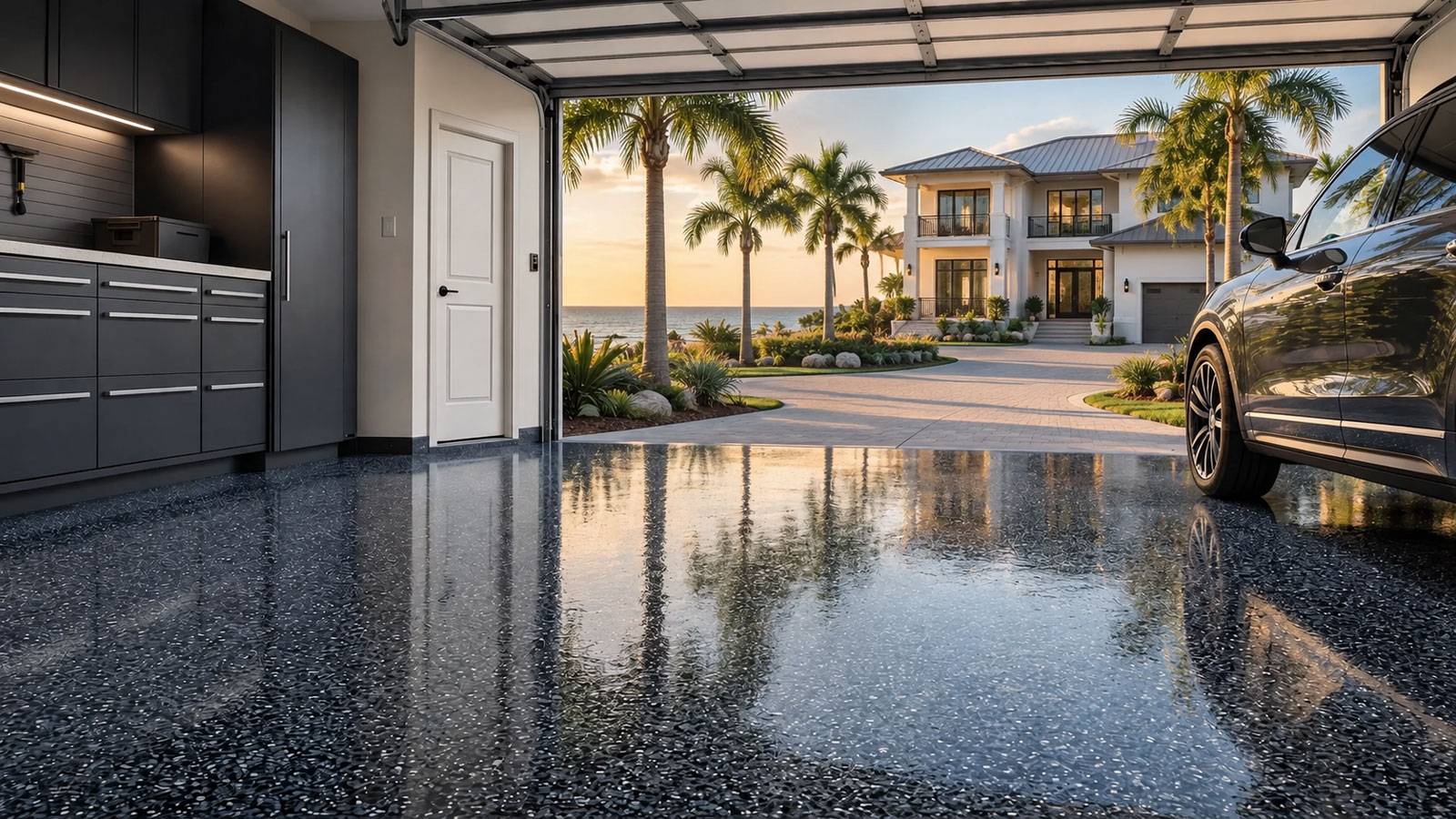
Garage Floor Coating in Stuart, FL
Garage floor coating guidance for Stuart homeowners considering epoxy, polyaspartic, and decorative flake finishes.
Floor Coating Guidance for Stuart, FL
For Stuart, the relevant local drainage issue begins with who actually operates the surrounding system. Stuart maintains a city Stormwater Division. That is a verifiable civic distinction, but it cannot tell a homeowner whether the concrete under a garage coating is sound or whether a previous paint layer is bonded. The first site question remains where rain travels across the private driveway and whether water actually crosses the threshold.
The public record also shows that the urban runoff system discharges toward the St. Lucie River and estuary. A second local point is that city stormwater maintenance and Martin County environmental projects are administered separately. These details explain why different parts of the Treasure Coast need different conversations about runoff and infrastructure. A public canal or treatment basin does not constitute a moisture test under an individual garage; exterior flooding and damp concrete are also different installation concerns.
In older Stuart garages and mixed-use concrete spaces downtown, previous floor paint, cracks, patches, oil residue, sunlight at the door and household storage can all change coating preparation. A quotation should identify mechanical profiling, removal of incompatible materials, functional control joints and the product's cure requirements. Proper epoxy or polyaspartic can help with ordinary cleaning when correctly bonded, but does not redirect a low driveway's water.
Local Market Insight
City of Stuart: Stuart maintains a city Stormwater Division; the urban runoff system discharges toward the St. Lucie River and estuary. This is public infrastructure context, not evidence of universal garage moisture trouble, and water entering a private garage must be assessed at the site.
What Affects the Cost of Garage Floor Coating in Stuart?
Pricing an existing Stuart garage calls for separating the publicly managed drainage system from the concrete itself. Stuart maintains a city Stormwater Division. Do not assume that a canal project or coastal location determines the appropriate resin barrier.
For Stuart, the relevant local drainage issue begins with who actually operates the surrounding system. This is useful when defining the scope of a Stuart garage estimate, not a basis for a citywide price premium. The published $6–$12 per-square-foot and $3,000–$5,500 typical two-car ranges are planning references only. Ask the bidder to itemize removal, grinding, any repairs and the full coating system before treating a quote as comparable.
Public pricing is typically $6–$12 per sq. ft., with $3,000–$5,500 for a typical two-car garage. The installed price depends on floor size, slab condition, coating system, old-coating removal, repair, moisture mitigation, and finish.
- Local government and drainage: Stuart maintains a city Stormwater Division. Clarifying the responsible authority helps distinguish public drainage from work on the owner's driveway, but does not diagnose slab moisture.
- Water-system documentary anchor: the urban runoff system discharges toward the St. Lucie River and estuary. This is a specific recorded project or jurisdictional fact, not evidence that any individual garage needs additional moisture products.
- Additional local distinction: city stormwater maintenance and Martin County environmental projects are administered separately. Ask about actual flow toward the door and any previous finish failure before concluding drainage or moisture is involved.
- Existing floor history: For older Stuart garages and mixed-use concrete spaces downtown, check old coatings, patches, sealers, contamination and the required mechanical profile. A building's neighborhood does not prove a slab is original or ready to coat.
- Cracks and access: The first site question remains where rain travels across the private driveway and whether water actually crosses the threshold. For a garage in Stuart, the relevant choice is the system specified for the existing slab, not the area's name. Discuss contamination and prior repairs first, then UV at the door, traction for wet shoes, cleaning habits and the manufacturer's application and vehicle-return limits. A decorative resin finish cannot compensate for unsupported concrete or for water entering from outside.
- UV and cure requirements: Compare the specified primer, flake, body and UV-stable topcoat, traction, parking use and manufacturer application limits before scheduling vehicle return.
Call for a clear, project-specific estimate — or request one online.
Stuart Drainage Responsibilities Versus a Garage-Floor Project
Stuart maintains a city Stormwater Division. This distinction in City of Stuart records is more useful to a homeowner than treating the entire Treasure Coast as one coastal environment. Public drainage responsibility identifies the agency to consult when exterior work is necessary; it does not establish whether an indoor slab is suitable for a resin finish.
The supporting documentation adds that the urban runoff system discharges toward the St. Lucie River and estuary. That fact belongs to a larger system serving waterways, roads or stormwater treatment. A residential driveway, however, may have a low apron, a blocked private path or no recurrent runoff problem at all. Observing what happens during rain is more reliable than interpreting the region's canal names as concrete test results.
A further distinction is that city stormwater maintenance and Martin County environmental projects are administered separately. Any contractor advice should preserve that specificity and avoid presenting a single project as protection for every nearby home. Wet tires depositing rainwater, outside runoff crossing a garage door and vapor through concrete are three separate questions.
A second local point is that city stormwater maintenance and Martin County environmental projects are administered separately. For a Stuart floor project, this distinction requires inspecting the actual garage doorway after rainfall rather than assuming public drainage predicts indoor conditions. Water carried in by tires, flow crossing a driveway lip and concrete that remains damp have different causes. Document them before any moisture-related product is proposed, and keep exterior drainage corrections separate from the finish.
Existing Concrete, Traffic and Finish Selection in Stuart
A homeowner in older Stuart garages and mixed-use concrete spaces downtown may have garage concrete with very different repair history from a neighbor's floor. A clean-looking surface can hide a sealer or an old coating, while a painted slab may require complete removal before reliable adhesion. The material manufacturer's profile requirements should control grinding and cleaning, not the age of the neighborhood.
A public canal or treatment basin does not constitute a moisture test under an individual garage; exterior flooding and damp concrete are also different installation concerns. The corresponding garage inspection should identify old paint and sealers, contaminated areas, patch compounds and the profile of sound concrete. Stable repairs and movement joints must be handled differently. Ask which areas near steps, shelving and edges are included in preparation and what happens if grinding exposes a weak prior finish.
A quotation should identify mechanical profiling, removal of incompatible materials, functional control joints and the product's cure requirements. The corresponding garage inspection should identify old paint and sealers, contaminated areas, patch compounds and the profile of sound concrete. Stable repairs and movement joints must be handled differently. Ask which areas near steps, shelving and edges are included in preparation and what happens if grinding exposes a weak prior finish.
Before accepting a bid, confirm every resin layer, repairs, edge details, return-to-foot-traffic and return-to-vehicle times, and clear exclusion of exterior grading. City of Stuart manages public responsibilities, while the installer must evaluate the particular concrete. Those separate roles are central to a trustworthy estimate.
Frequently Asked Questions
Which government handles drainage around Stuart?
Stuart maintains a city Stormwater Division. Ask which authority or association maintains the particular street or canal rather than assume all drainage is municipally operated.
Does the documented local water system mean I need a moisture barrier?
No. the urban runoff system discharges toward the St. Lucie River and estuary. That cannot diagnose an individual concrete slab; inspect genuine dampness, old coating failure and runoff before recommending additional products.
What other local fact matters here?
city stormwater maintenance and Martin County environmental projects are administered separately. That point may shape local drainage questions but does not prove any garage floor is wet or suitable for a particular resin.
Can an epoxy or polyaspartic coating stop stormwater entering the garage?
No. Persistent exterior flow requires a driveway, door or drainage remedy separately from an indoor floor finish.
What must my Stuart coating quote specify?
City of Stuart: Stuart maintains a city Stormwater Division; the urban runoff system discharges toward the St. For a Stuart floor project, this distinction requires inspecting the actual garage doorway after rainfall rather than assuming public drainage predicts indoor conditions. Water carried in by tires, flow crossing a driveway lip and concrete that remains damp have different causes. Document them before any moisture-related product is proposed, and keep exterior drainage corrections separate from the finish.
Stuart Neighborhoods & Local Context
Phone Quote Line
Talk through your concrete condition, coating options, and estimate range.
(772) 919-9196Typical Project Cost
$3,000–$5,500
Typical range for a standard two-car garage. Final pricing depends on size, concrete condition, preparation, system, and finish options.
Helpful Guides